


Leadership Development Programme Emergency Care
The Challenge
NHS emergency departments deliver critical care in environments of sustained, intense pressure. Maintaining safe and efficient patient flow is essential and is an ongoing challenge, with waiting time performance closely monitored across the system. Persistent operational pressures also affect staff morale, making it even harder to deliver timely care alongside a positive patient experience.
Our client was experiencing significant difficulties with urgent and emergency care waiting times – ranking among the lowest performers nationally. Patient flow required improvement. Strengthening leadership was prioritised as a crucial step in driving the improvements needed across the department.
We were asked to deliver a leadership development programme to enhance leadership in practice. Central to this was fostering open and honest relationships among band 7 leaders and supporting them to: reflect on their leadership style, build greater self-awareness, and apply new concepts and skills to lead with confidence in a challenging and complex environment.
When I walked into the room, I was met by an open, engaged group of Band 7 leaders who were honest about their challenges but equally focused on creative solutions. They spoke honestly about their challenges, but their strong sense of ownership for culture, care, and leadership was impressive. I was genuinely impressed by how far they have already come together.
Chief Nurse
I’ve enjoyed learning about my leadership style, my colleagues’ leadership styles and how I need to adapt to work with them constructively.
What we did
We delivered three leadership development modules for twenty-five band 7 emergency department ward managers, co-ordinators and service leaders. Each module was two days long and focused on a different aspect of leadership.
Module 1: Leading self. Leaders were supported to reflect on their current leadership style, preferences and behaviours and to explore what they could adapt to enhance their personal impact and strengthen working relationships. Through developing their reflective and reflexive capabilities, each leader identified and set personal development goals based on where.
Module 2: Leading teams. This module focused on the principles and practices of leading high performing teams. Leaders were given time and space to understand different perspectives across their leadership cohort and to define a shared ambition for improving culture, collaboration and teamwork. They also learnt and practiced new skills for managing conflict, handling difficult conversations and addressing unwanted behaviours.
Module 3: Leading cultures. The final module explored how leadership practice shapes service quality and culture. It focused on patient safety and risk management, as well as strengthening leaders’ cultural competency to promote equity, diversity and inclusion, and to apply cultural sensitivity in both patient care and team interactions. Leaders also learnt and practiced skills in mentoring and coaching to support a culture of continuous growth and improvement.
I’ve really enjoyed working with Urgent & Emergency Care colleagues and getting to know that none of us are in this alone!
The Results
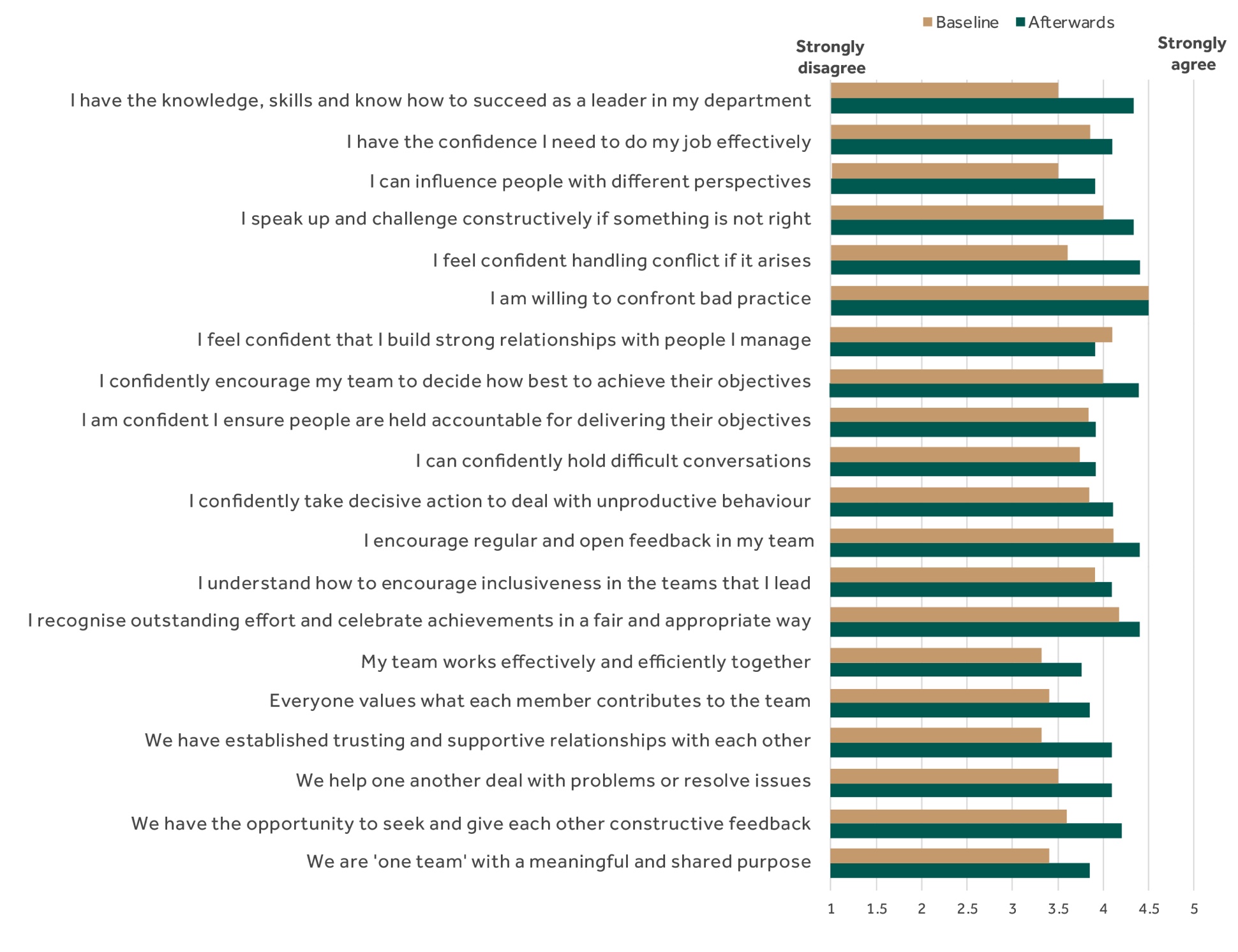
Leaders completed a self-rated survey before and after the programme to evaluate its impact. Ratings across individual and collective leadership objectives consistently improved, indicating increased leadership confidence and competence.
Alongside improving individual knowledge, skills and capability, significant gains were seen in how leaders worked together. They reported a stronger sense of ‘one team’, more trusted and supportive relationships, helping one other to resolve problems and giving and receiving feedback constructively.
One exception to the improved ratings was a slight decrease in leaders’ perceptions of their relationships with the staff they manage. This may reflect increased self-awareness and higher expectations of themselves generated through the programme – highlighting opportunities for improvement rather than a decline in capability. This is expected to improve as leaders apply the learning and actions from the programme.
Qualitative feedback reinforced the value leaders gained, emphasising increased confidence, stronger working relationships and the understanding of practical skills they can apply in their roles.
I valued learning about myself as a leader and how I can implement the tools and strategies from the course in practice. I have some good ideas to implement into my area. My goal is to involve my whole team.

Results from a 5-point Likert scale self-rating survey to assess the programme’s development objectives:

Results are testament to our client’s determination to change and the power of acorn to unlock their potential.
Leadership development
Every acorn programme is co-designed with you, ensuring it’s tailored to your goals.

Excellent team building and further cohesive working. Really enjoyable and productive.

Contact acorn
Our focus on building trusting relationships lies at the heart of our success.