


NHS Hospital Leadership Team
The Challenge
Emergency Departments (EDs) across the NHS face significant pressure on services. Transformation and sustainable improvements are essential to cope with increasing patient demands.
Our client was experiencing ongoing challenges with ED access and waiting times, as well as patient experience and quality of care. Five new triumvirate leadership teams were formed across the service group to accelerate service improvements.
We were asked to deliver a leadership development programme to help these newly established teams build trusted relationships and a shared leadership purpose. A focus was to strengthen collaboration, improve leadership confidence, and equip leaders individually and collectively with the skills and capability to drive innovation, manage change and maintain a culture of continuous improvement.
Bringing all the theory together has truly delivered remarkable results and instilled a strong sense of purpose within the senior team. Their confidence and trust have grown exponentially, fuelling a renewed ambition and deep pride in what we’re achieving.
It’s been incredible to witness such transformation—what a team, and what a journey! On a personal level, I felt the weight of imposter syndrome lift, and it gave me a renewed sense of confidence in my leaders.
Service Group Director
What we did
We delivered three leadership development modules for the five triumvirate teams in the ED service group. Each module was two days long and focused on a key aspect of leadership.
Module 1: Building the team. Leaders were invited to review and reflect on their individual and collective strengths, drawing on insights from previously completed StrengthscopeTM self-assessments. A guest speaker session focused on enhancing personal impact. Working together, the teams then defined their shared purpose, development goals, success measures and agreed approaches for managing conflict.
Being able to speak openly and honestly helped my confidence as a leader. Knowing we can trust each other to challenge and feed back professionally is invaluable.
Module 2: Deepening team psychological safety and effectiveness. This module focused on the principles of high performing teams and provided time and space for the triumvirates to identify their service improvement priorities through appreciative enquiry and exploration of where improvement was most needed. Each team developed action plans and set individual commitments to drive ongoing team development and service improvement.
Module 3: Enabling team resilience. The final module focused on exploring team and individual resilience and included experiential resilience building exercises. The leaders reflected on their development journey, celebrated successes, and agreed their next steps in their action plans.
The Results
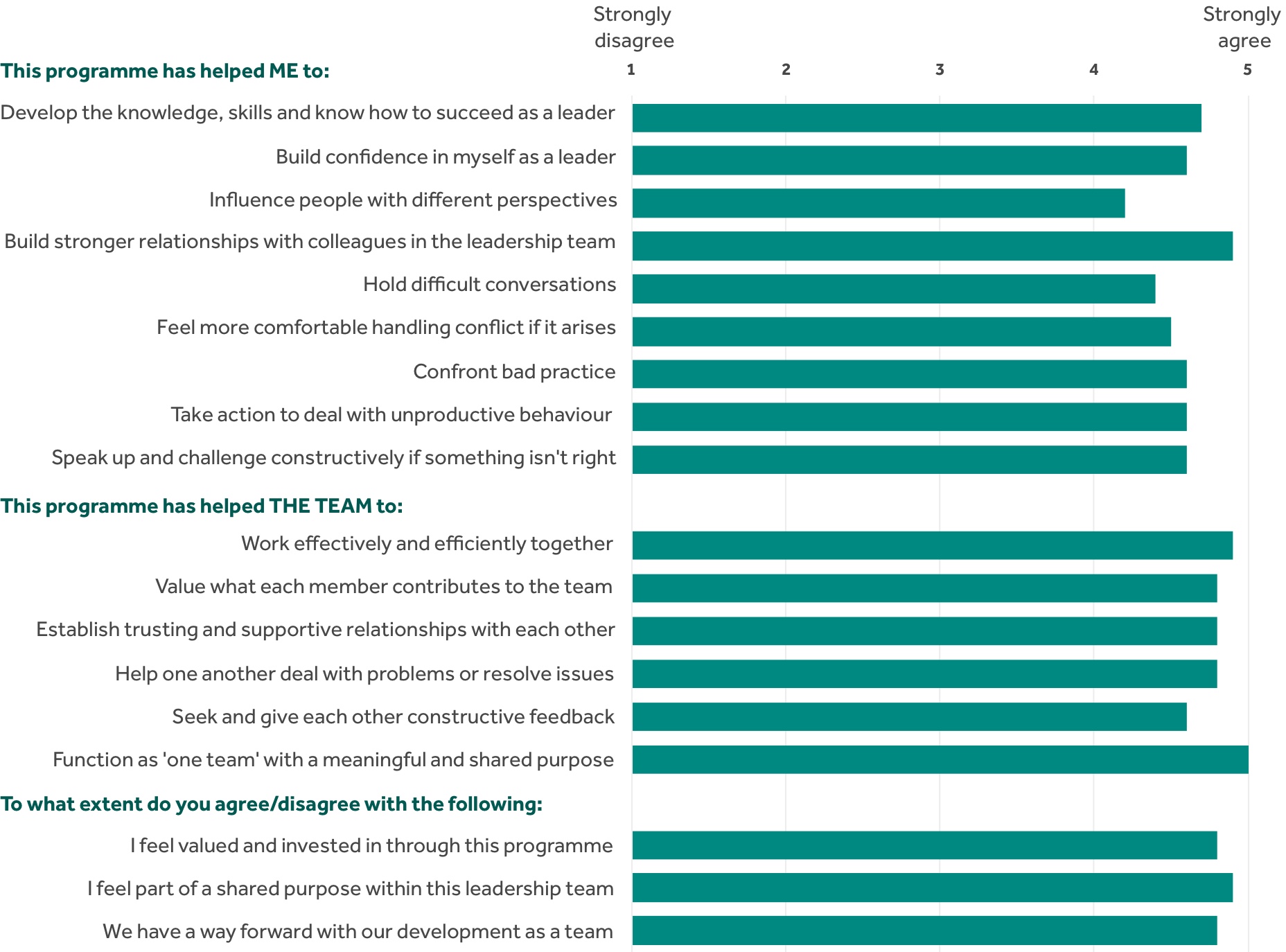
Leaders completed a self-rated survey following the programme to evaluate its impact. The survey assessed perceptions of individual and collective leadership capability and team culture. Results showed consistently high scores, demonstrating the programme’s impact on both improved confidence and competence at the individual and team levels.
Overall, the triumvirate leaders reported feeling confident in themselves as leaders and equipped to improve services, address conflict, challenge poor practice and hold difficult conversations. They also reported strong trusted relationships within their teams, including being able to provide constructive feedback, support each other and work effectively towards a shared purpose. Qualitative feedback on the programme reinforced the value leaders gained.
Additionally, ‘tests of change’ reports on ED performance following the programme showed marked performance improvements. While these improvements cannot be directly attributed to the programme, the triumvirate teams strongly believe that their development during it, which strengthened their teamwork, shared purpose and service improvement planning, contributed to their success (below).
| Service improvements documented in internal ‘test of change’ tests across ED: | |
|---|---|
| Handover Performance (<45 Minutes) | 158% improvement |
| Ambulance handover time lost | 83.9% |
| ED attendance waiting (>12 hours) | 20.5% |
| Total ED turnaround (time in minutes) | 25.3% |
| Patients awaiting admission (at 9am) | 38.7% |

Results from a 5-point Likert scale self-rating survey to assess confidence and competence across each of the programme’s development objectives, as well as the impact on team culture.

Results are testament to our client’s determination to change and the power of acorn to unlock their potential.
Team coaching and development
Whatever you want for your team, development is serious work and needs expert facilitation and a supportive environment.

Excellent team building and further cohesive working. Really enjoyable and productive.

Contact acorn
Our focus on building trusting relationships lies at the heart of our success.